


Buying property in Pune already feels like a major milestone, and you have probably already heard that you must “check the papers” before paying anything. The gap is that most buyers still do not know which documents actually matter, how title verification works, or where legal trouble usually hides. In this guide, you will learn exactly what property document verification Pune involves, which records to review, what red flags to spot, and when professional legal help makes the purchase safer.
Key Takeaways
- Property document verification is the legal examination of ownership records, title history, approvals, and liabilities before a property transaction.
- Title clarity helps buyers confirm that the seller has a lawful and transferable right to sell the property.
- Property due diligence in Pune usually includes sale deed review, encumbrance checks, tax receipt validation, sanctioned plan checks, and identity verification.
- Legal review reduces the risk of buying disputed, mortgaged, unauthorized, or illegally constructed property.
- Local verification matters because Pune properties may involve MahaRERA, Sub-Registrar records, PMC or PMRDA permissions, and society-level documents.
- A lawyer’s legal opinion can expose title gaps, approval issues, and missing records that many buyers overlook.
- A verified file set makes the next stages, including agreement drafting, loan processing, registration, and possession, much safer.
What Is Property Document Verification in Pune?
Property document verification in Pune is the legal examination of ownership records, title history, approvals, tax records, and liabilities before you buy, sell, inherit, or invest in a property. In practical terms, it means checking whether the seller truly owns the property, whether the title is clear, whether the property is free from hidden loans or disputes, and whether the construction has the right municipal or development approvals.
First, property document verification and property title verification Pune are closely related, but they are not identical. Title verification focuses on lawful ownership and transferability. Document verification is broader because it also includes approvals, society papers, identity checks, tax compliance, and transaction records.
For example, a flat may have a registered sale deed, but the building may still have approval issues, unpaid dues, or incomplete occupancy records. That is exactly why buyers search for a property verification lawyer Pune, a property legal check Pune, or a property due diligence Pune service before paying token money.
Moreover, Maharashtra’s property ecosystem is increasingly digital. The Department of Registration and Stamps provides e-Search, property search, and registration-related digital services, while PMC and PMRDA offer online civic and development permission services. This makes verification easier, but it does not replace legal analysis.
property registration process in Pune
Why Is Property Document Verification Important Before Buying a Flat or Plot in Pune?
Property document verification matters because it helps buyers avoid fraud, defective title, hidden mortgages, illegal construction, and future litigation. A property may look attractive on-site, yet still carry legal risk on paper.
First, title verification involves confirming that the seller has a clear and transferable legal right over the property. That matters because ownership problems do not always show up during site visits. For example, a resale flat can involve inheritance issues, old family claims, society transfer restrictions, or missing links in the title chain.
Second, a property encumbrance check helps buyers identify whether the property is mortgaged, disputed, or legally restricted. The Maharashtra Registration Department provides e-Search and related record-search tools precisely because citizens need to examine registered transactions and property-related records before proceeding.
Third, Pune buyers must also think locally. Property verification in Pune often depends on which authority governs the area, such as PMC, PMRDA, or another planning authority. PMC’s Building Development Department issues necessary permits and certificates for properties in its jurisdiction, while PMRDA lists services such as layout/building permission, zoning certificate, and occupancy certificate.
At the same time, the scale of Maharashtra’s regulated real-estate market shows why document checking cannot be casual. MahaRERA’s statistics page reports 53,847 project registrations granted and 18,933 completed projects as per Form 4 in Maharashtra at the time of access — Source: MahaRERA Statistics, 2026. The same portal also shows 54,758 agent registrations granted — Source: MahaRERA Statistics, 2026. Large markets create more opportunity, but they also demand stricter buyer due diligence.
Which Documents Should Be Checked Before Buying Property in Pune?
The documents to verify before buying property in Pune include title documents, transaction documents, encumbrance records, tax receipts, identity papers, authority approvals, and society records. The exact checklist changes slightly for plots, resale flats, and builder properties.
Which core ownership and transaction documents matter most?
First, you should usually start with these papers:
- Sale deed / previous sale deeds
- Agreement to sale
- Mother deed or title chain documents
- 7/12 extract or property card, depending on the nature and location of the property
- Mutation entries
- Possession letter, if applicable
- Index II / registration extract
- Identity and PAN/Aadhaar details of the seller
Moreover, Maharashtra’s digital property ecosystem specifically references access to property card, digitally signed 7/12 and property card, mutation-related information, and registration records through official systems.
Which liability, approval, and society documents should also be checked?
Second, buyers should also verify:
- Encumbrance or transaction search records
- Home loan / mortgage status
- Latest property tax receipts
- Approved building plan / sanctioned layout
- Commencement Certificate
- Occupancy Certificate or Completion Certificate, where relevant
- MahaRERA registration details for applicable projects
- Society NOC, share certificate, maintenance dues, and transfer papers for cooperative housing properties
For example, PMC provides online services related to Property Tax – Pay Online and Property Tax NOC, which makes local tax validation an important part of the review. PMRDA publicly lists development-permission services including layout/building permission and occupancy certificate, making those approvals especially relevant for projects in PMRDA-governed areas.
Quick checklist table for buyers
| Document Category | What It Confirms | Why It Matters |
|---|---|---|
| Sale deed / title chain | Ownership flow | Reveals lawful transfer history |
| 7/12 / property card | Land or city record identity | Helps match survey/CTS and ownership entries |
| Encumbrance / search report | Loans, charges, prior transactions | Detects mortgage or title complications |
| Tax receipts | Municipal compliance | Helps identify unpaid dues |
| Sanctioned plan / CC / OC | Construction approval status | Protects against unauthorized construction |
| MahaRERA details | Project registration and disclosures | Useful for new projects and under-construction units |
| Society records | Transferability in cooperative housing | Flags maintenance, share, or NOC issues |
How Does the Property Document Verification Process Work Step by Step?
The property document verification process works by collecting papers, checking ownership continuity, reviewing registered records, validating approvals, checking liabilities, and issuing a legal opinion. A proper review is sequential, not random.
Step 1: Collect the full document set
First, ask for copies of every title, approval, and identity document from the seller or builder. If the seller only shares selected pages or avoids older title records, that itself is a caution sign. Incomplete paperwork is often the first red flag in a property transaction.
Step 2: Match the property identity across all papers
Second, check whether the flat number, survey number, CTS number, plot number, area, building name, and boundary details are consistent across every document. For example, the sale deed, tax bill, society records, and sanctioned plan should all refer to the same property without conflicting descriptions.
Step 3: Verify title chain and seller capacity
Third, trace how ownership passed from one holder to another. This is where property title search Pune and sale deed verification Pune become essential. If the seller inherited the property, ask for succession papers. If a company is selling, verify board authority and signatory capacity.
Step 4: Search registration and encumbrance records
Fourth, search official registration records. Maharashtra’s Registration Department offers e-Search and related record-search tools, while its broader ease-of-doing-business pages also reference record-of-rights, property card access, and non-encumbrance-related pathways.
Step 5: Validate taxes, approvals, and authority records
Fifth, confirm local tax compliance and building permissions. PMC handles property tax assessment and collection for properties in its jurisdiction, and its services include Property Tax NOC. PMC’s Building Development Department is responsible for issuing permits and certificates. PMRDA separately lists services such as layout/building permission, zoning certificate, and occupancy certificate.
Step 6: Obtain a legal opinion before payment
Finally, a lawyer prepares a property legal opinion Pune note summarizing title quality, pending risks, missing papers, and safe next steps. A legal opinion on property documents helps buyers reduce the risk of fraud, title defects, and future ownership disputes.
How Can You Verify Property Ownership, Title Chain, and Encumbrances in Pune?
You can verify property ownership and title in Pune by examining the title chain, checking registration records, matching land or city records, and reviewing encumbrances or mortgage indicators. The goal is to confirm that the seller’s right is real, continuous, and transferable.
What is the difference between title verification and document verification?
First, title verification asks one core question: Does this seller legally own the property and have the right to transfer it? Document verification asks a wider question: Are all legal, regulatory, and transactional papers in order? A property can pass one test and fail the other.
For example, a seller may have inherited valid ownership, but the building could still face approval or occupancy issues. That is why a property papers check Pune must include both title and compliance.
How do you check if a property has a loan, dispute, or encumbrance?
Second, review the registration history and ask for lender release documents if any loan previously existed. Also inspect whether a bank NOC, no-dues letter, or charge-release document is needed. Maharashtra’s property-record search tools were built to help citizens examine registered transactions and property details before moving ahead.
Moreover, official system integration in Maharashtra is designed to connect registration with land-record details such as 7/12 and property card, and even party verification through PAN and Aadhaar during registration workflows. That makes identity and land-record matching especially important during legal review.
Which Builder Approvals and Municipal Permissions Should Be Verified in Pune?
The approvals that should be verified in Pune include project registration status, sanctioned plan, layout approval, commencement documents, and occupancy or completion records from the relevant authority. The exact authority depends on the project location and jurisdiction.
First, for many new projects, MahaRERA verification is a basic starting point. MahaRERA’s promoter guidance and FAQs list required registration materials such as legal title report, encumbrance certificate, copy of layout approval, building plan approval, and valid commencement certificate for project registration. That gives buyers a practical clue about which papers deserve attention even before signing.
Second, not every project requires RERA registration. MahaRERA’s promoter guidance states that a project may be exempt where the proposed development does not exceed 500 square meters or 8 apartments, subject to the law’s conditions and exceptions. Buyers should therefore not assume that the absence of a RERA number automatically means illegality, but it does mean the paper trail needs closer scrutiny.
Third, for Pune local approvals, PMC and PMRDA matter a lot. PMC’s Building Development Department issues permits and certificates for properties in its area, and PMRDA publicly lists services including layout/building permission, zoning certificate, occupancy certificate, and related permissions.
How Is Document Verification Different for Resale Property and New Projects?
Document verification is different for resale property and new projects because resale deals require deeper ownership-history checks, while new projects require stronger approval and builder-compliance checks.
First, in a resale flat document verification Pune case, the title chain becomes central. You need to check earlier sale deeds, inheritance documents if applicable, society transfer papers, share certificate, maintenance dues, tax receipts, and actual possession history. A resale deal often carries hidden human-history risk, not just paper risk.
Second, in a builder property document check Pune case, project-level compliance matters more. You should verify MahaRERA status where applicable, land title, sanctioned plans, commencement records, construction permissions, and occupancy stage. For example, PMRDA’s documentation framework for permissions and occupancy-related applications shows how document-heavy approval compliance can be in development projects.
Third, a practical rule helps: resale verification is title-heavy, while new-project verification is approval-heavy. In both cases, however, you still need identity verification, payment documentation, and a final legal opinion.
What Are the Common Red Flags in Property Papers?
Common red flags in property papers include broken title chain, mismatch in property description, missing approvals, hidden loans, unpaid dues, and reluctance to share original records. Red flags usually appear as inconsistencies, omissions, or urgency tactics.
First, watch for these warning signs:
- Seller name does not match the title record
- Area or unit description changes across documents
- Old deeds are missing without explanation
- Property tax or society dues remain unpaid
- Project approvals are unclear or incomplete
- Builder or seller pressures you to pay before legal review
- Mortgage closure proof is missing
- Possession exists, but occupancy records are unclear
Moreover, MahaRERA publicly maintains not only project search, but also categories such as lapsed projects, revoked projects, abeyance lists, and other compliance-related categories. That alone tells buyers that project status can change and should be checked, not assumed.
A simple rule works well here: clean-looking brochures do not prove clean legal title. For example, a polished site office in Pune cannot fix a defective title chain or missing authority approvals.
When Should You Hire a Property Verification Lawyer in Pune?
You should hire a property verification lawyer in Pune before paying a large token amount, signing an agreement, buying a resale property, purchasing inherited property, or dealing with unclear approvals. Early review is cheaper than late litigation.
First, legal help becomes especially important when:
- the property is old or repeatedly resold,
- the seller inherited it,
- the project is under construction,
- the property lies in a fringe or rapidly developing Pune area,
- the paperwork is incomplete,
- or the bank’s review feels too limited.
Second, do not confuse bank legal review with buyer-side due diligence. A lender checks the property mainly for lending risk. Your lawyer checks it for your ownership safety. Property due diligence in Pune involves checking sale deeds, encumbrances, tax receipts, sanctioned plans, identity documents, and local authority records.
How much does property document verification cost in Pune?
Property document verification cost in Pune usually depends on complexity, not just document count. A simple flat purchase may cost far less than a land parcel, inheritance matter, or builder-dispute review. Fees often vary based on title depth, number of historical documents, urgency, and whether a written legal opinion is included. Because fees are market-driven and service-specific, it is best to ask for a scope-based quote in advance.
Which Tools, Checklists, and Real-World Examples Help with Property Document Verification in Pune?
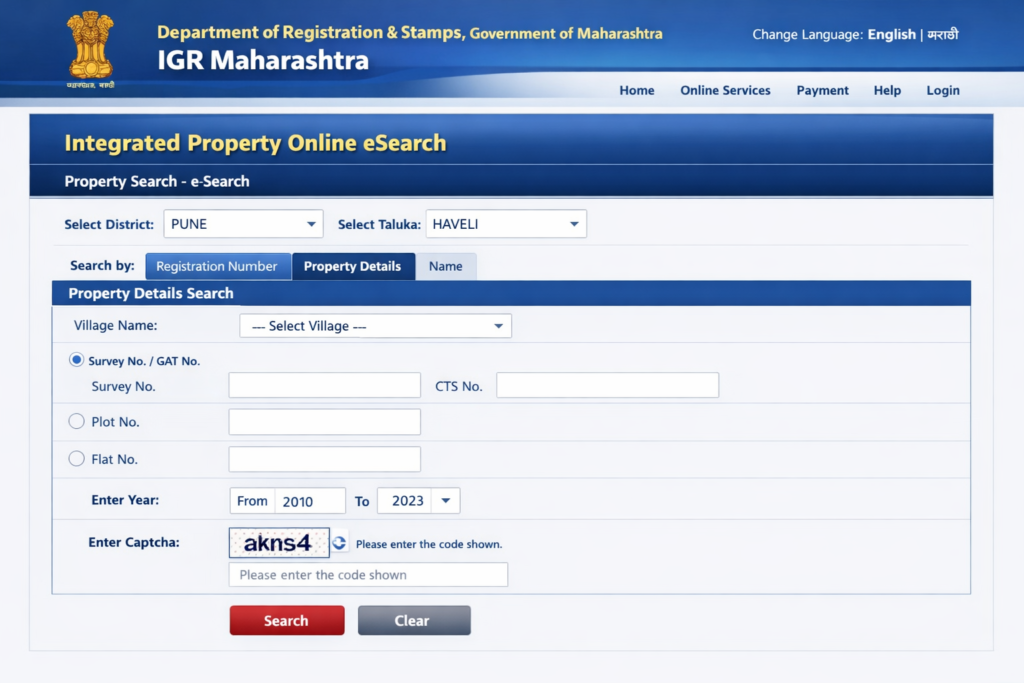
The best tools for property verification in Pune are official record portals, a document checklist, and a lawyer’s written issue tracker. Tools do not replace legal judgment, but they make the process more transparent and organized.
First, useful official touchpoints include:
- IGR Maharashtra for registration-related search and record tools
- MahaRERA for project search, promoter disclosures, and compliance status
- PMC for property tax and civic service checks
- PMRDA for development-permission and occupancy-related workflows
For example, Maharashtra’s Registration Department reports 3,281,985 total documents registered and ₹36,635.38 crore total revenue collected for FY 2025–2026 on its statistics page at the time of access — Source: Department of Registration & Stamps, Maharashtra, 2026. It also reports 837,437 Article 25 conveyance/sale documents and ₹16,830.55 crore revenue under that category — Source: Department of Registration & Stamps, Maharashtra, 2026. That volume shows why buyers should rely on systematic review, not assumptions.
A simple real-world example
Let’s take a common Pune case. A buyer likes a resale flat in a society near a fast-growing suburb. The seller shares the latest sale deed and tax bill. A deeper review, however, shows an older title gap, pending society dues, and unclear occupancy paperwork. That single legal review can save the buyer from years of post-purchase trouble.
What Should You Do After the Property Documents Are Legally Verified?
After the documents are legally verified, you should move carefully into agreement drafting, payment structuring, registration planning, and possession-related safeguards. Verification is not the end; it is the point where safer execution begins.
First, ask your lawyer to confirm whether the file is:
- legally clear,
- clear subject to conditions, or
- risky and not recommended.
Second, if the papers are acceptable, move toward:
- drafting or reviewing the agreement to sale,
- defining payment milestones,
- checking stamp duty and registration requirements,
- collecting originals at closing,
- recording possession terms,
- and preserving all receipts, correspondence, and declarations.
Third, make sure post-verification execution aligns with the legal findings. For example, if a mortgage release or society NOC is still pending, your payment structure should reflect that risk.
Frequently Asked Questions
Common questions about property document verification in Pune — answered by Adv. Bramhadev Shivdas Lokare.
Have a specific question about your property? Get a legal opinion from Adv. Bramhadev Shivdas Lokare.
Conclusion: Safe Property Buying Starts with Proper Verification
Property document verification in Pune is the foundation of a safe property purchase because it tests ownership, title continuity, approvals, tax compliance, and legal risk before your money is locked in. That one step can make the difference between a secure investment and a costly dispute.
Ultimately, property document verification is the legal examination of ownership records, title history, approvals, and liabilities before a property transaction. If you are buying a flat, plot, resale unit, inherited property, or commercial space in Pune, do not treat document review as a formality. Treat it as your first line of protection.
Written by: Advocate Bramhadev Shivdas Lokare, B.Com, M.Com, LL.B — legal practitioner handling civil, criminal, conveyancing, and property-related matters, with a practical focus on legal documentation and due diligence in property transactions.
Reviewed by: Legal Editorial Review Team, property documentation and conveyancing review desk.
Content brief reference: Publisher-provided SEO and content framework.
Disclaimer: This article was initially drafted using AI assistance. However, the content has undergone thorough revisions, editing, and fact-checking by human editors and subject matter experts to ensure accuracy.